Overview
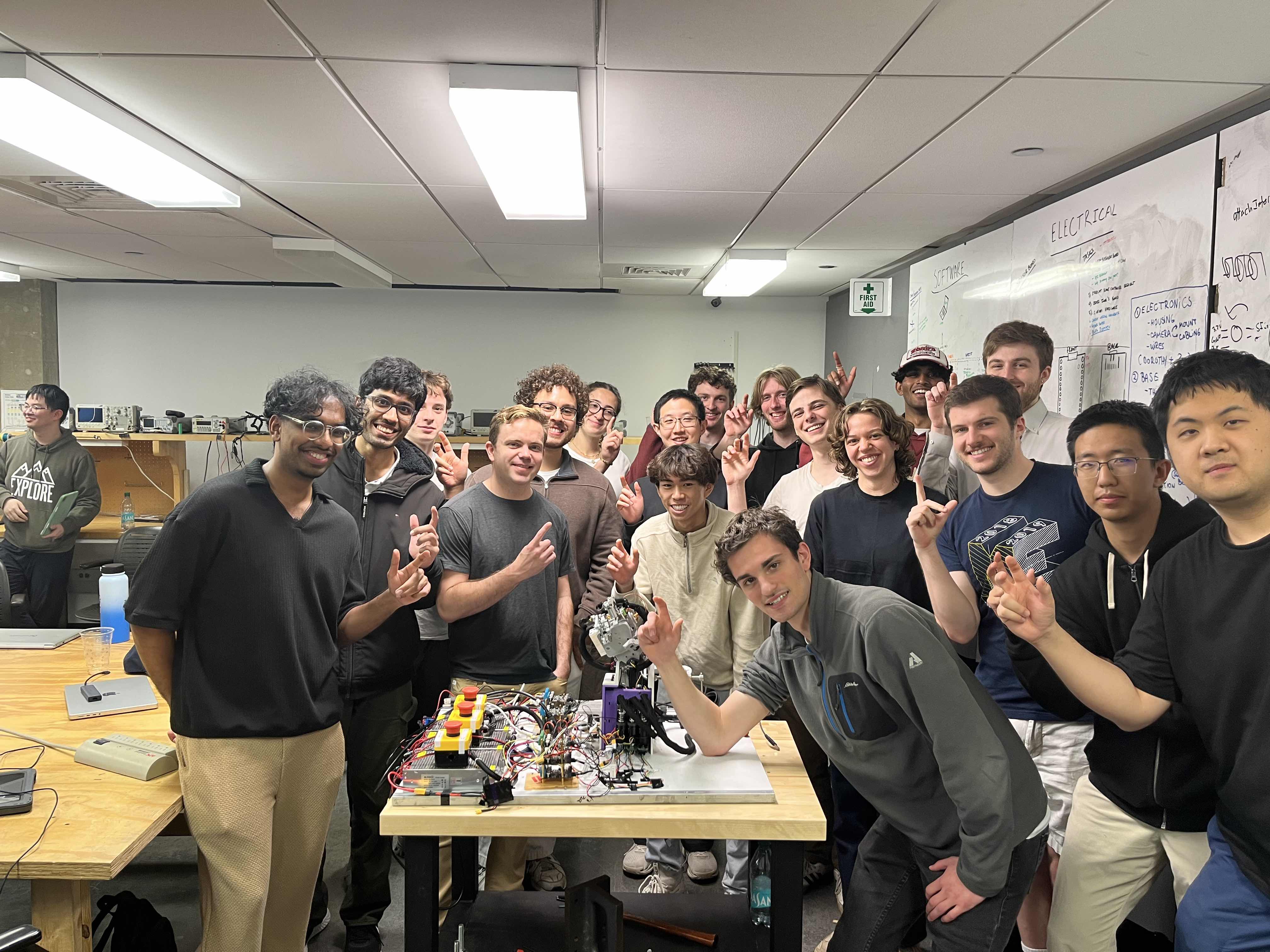
This was a two-quarter course project focused on designing and controlling a robotic hand. The work was carried out in two phases. In the first milestone, three teams (each with 6–7 members) were tasked with building and controlling a 2-DOF tendon-driven finger within 3 weeks. In the second milestone, all 20 students came together to build a complete robotic hand consisting of:
- A 2-DOF wrist (pitch and yaw)
- A forearm housing all the motors and series elastic actuators
- A 4-DOF dexterous finger
- A 1-DOF power finger
Milestone 1 – Finger Prototype
I was part of the N team, where we had to design a 2-DOF finger using an N-routing scheme — the number of actuators matched the number of independently controlled joints.
Key Components
- Motors: Brushless outrunners with 22.6:1 gear ratio, controlled via ODrive
- Encoders: AS5147 magnetic encoders
- Finger: Tendon-driven with modular routing
- Microcontroller: Teensy 4.x (CAN for motor control, SPI for encoder feedback)
- Interface: USB connection to a host PC for command input and data visualization
My Contributions
- Set up all electrical connections
- Controlled motors using ODrive over CAN via Teensy
- Implemented finger kinematics and encoder integration using SPI
- Tuned PID gains for smooth joint control
Code
The code for milestone 1 is available at https://github.com/NU-RDS/team-n-testbench
Results
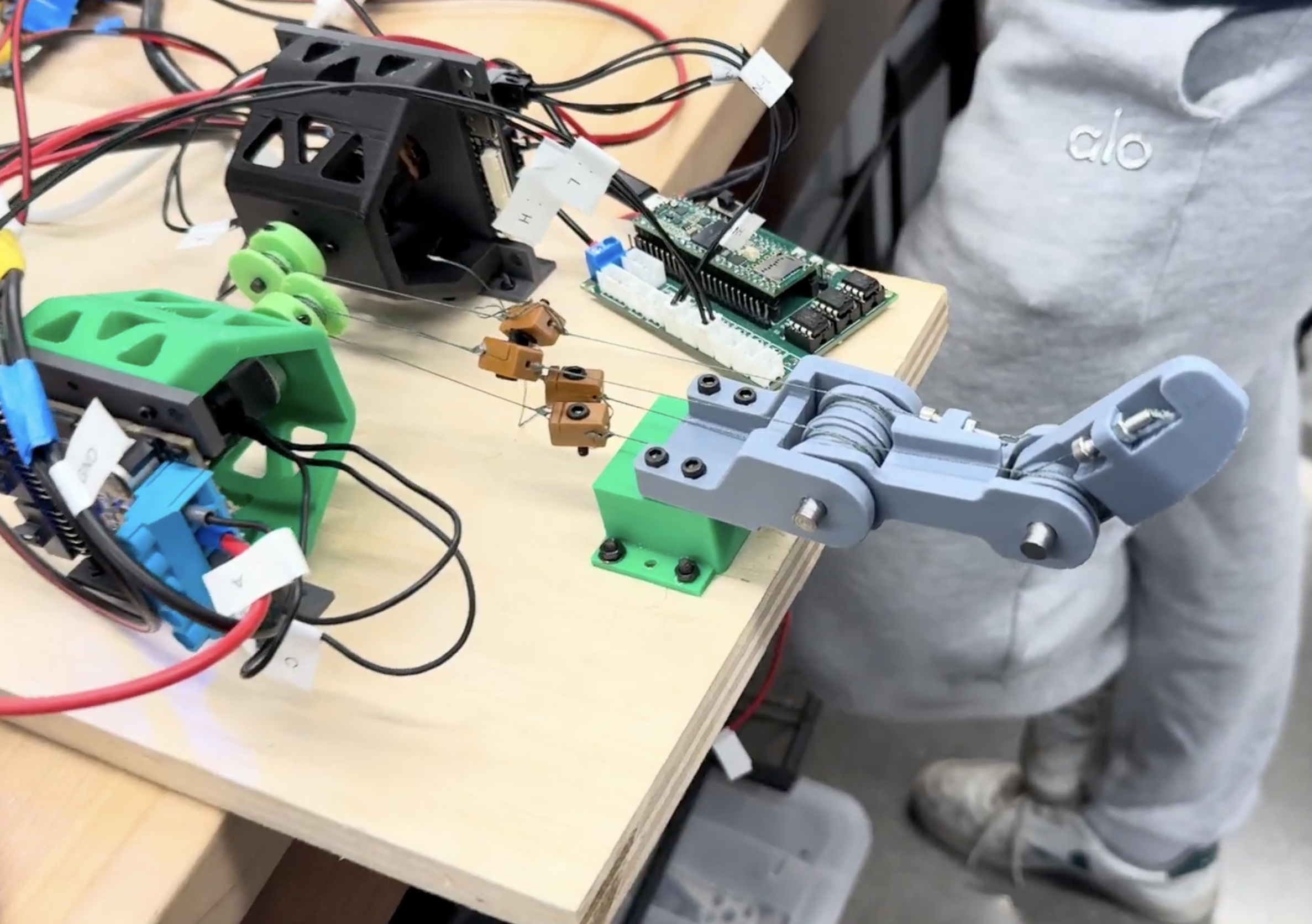
Team N robot finger
Finger max force test
Milestone 2 – Full Hand Integration
In the second milestone, all teams worked together to build the full robotic hand. This included the integration of the wrist, fingers, palm, and forearm along with a custom embedded control stack.
Key Components
-
Dexterous Finger: N+1 configuration (3 DOF + passively actuated MCP joint)
- Power Finger: Underactuated mechanism using 2 × 5-bar linkages
- Wrist: 2 DOF (pitch and yaw), supports routing of seven tendons
- Palm: Provides a compliant surface and connects wrist and fingers
- Forearm: Houses multiple SEA modules (motor + torsional spring + encoder) for backdrivable actuation
Software Architecture
- User Interface: GUI for sending commands, tuning PID gains, and real-time plotting/logging
- High-Level MCU: Parses commands, handles kinematics, and runs position PID control
- Low-Level MCU: Runs force control loop using SEA data and sends torque/current commands to motors via ODrive Pro
- Palm/Sensor Boards: Collect joint and force data and pass it to the high-level controller
- Communication Library: Custom CAN protocol (rds25-comms) for communication across all MCUs
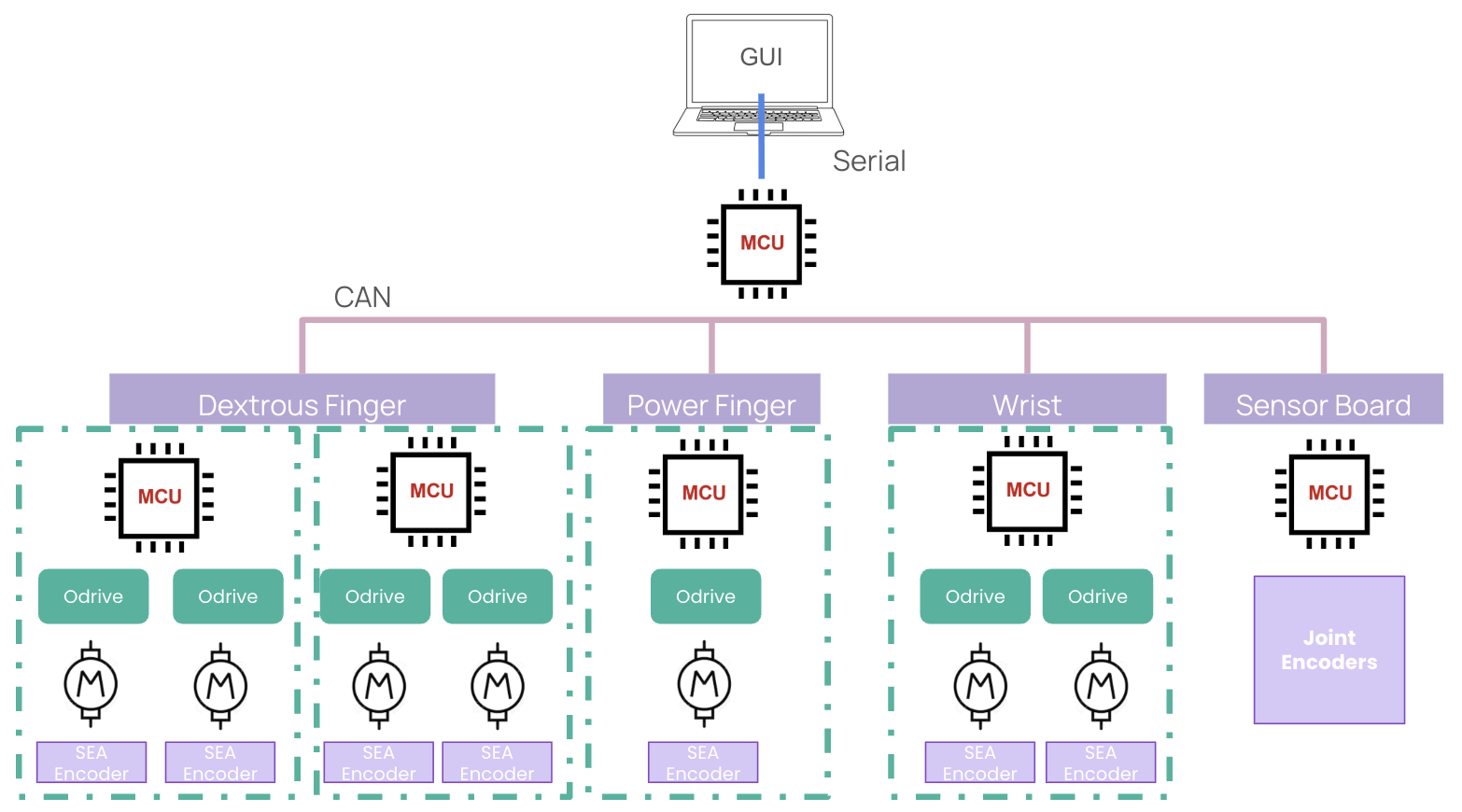
High level software architecture
My Contributions
- Helped design the full software architecture
- Worked out the kinematics for the full hand
- Developed both position and force PID control
- Integrated AS5147 encoders via SPI and load cells via UART with the MCU
- Characterized the torsional springs in the SEA modules
- Handled motor communication with the ODrives using CAN on Teensy 4.0/4.1
Code
The code for milestone 2 is available at https://github.com/NU-RDS/rds25-project
Results
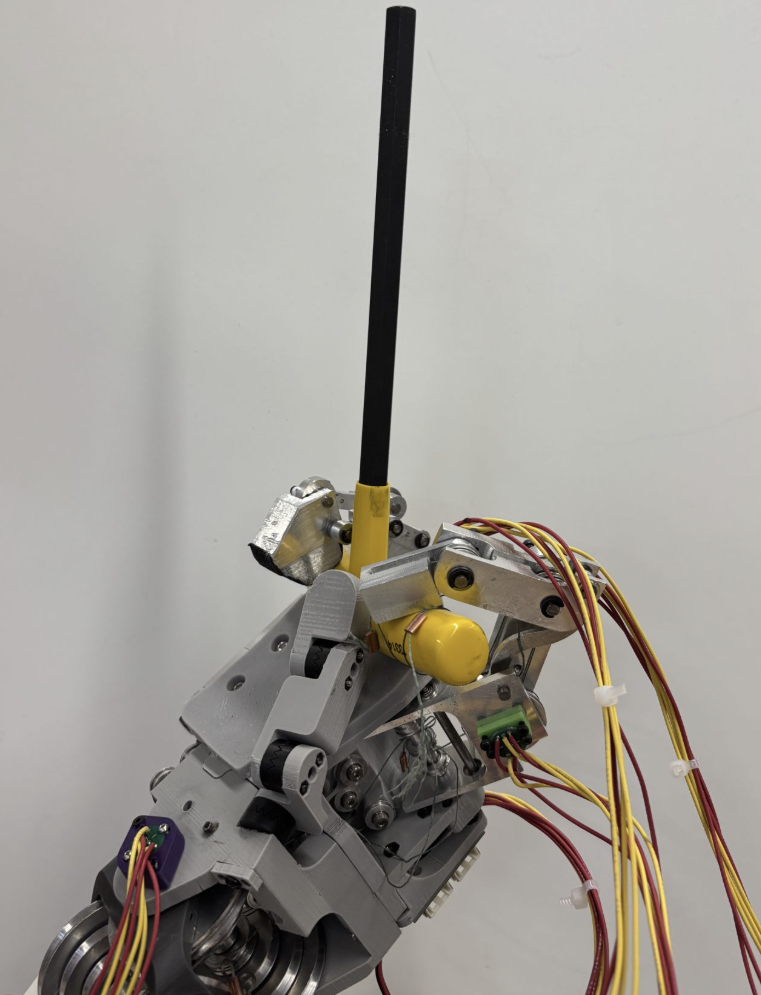
Robot hand holding a tool
Yaw Control
Pitch Control
Team